Uncategorized

The Difference Between RSA and ISA and how it relates in today’s society

Posted by Jeff Allred (he/him/his) on

In this reading Louis Althrusser expands upon Marxist “Theory of the State” by adding to the definition of the repressive State apparatus and also adding a new term called ideological state apparatus. The repressive state apparatus is used by the people in power to control the people in the society.  The keyword being repressive meaning to repress the people to follow the rules that are imposed. Althrusser says this is done by ” The state functions by violence.”(1341)  He states this is done by the government, the army, the police, but you can also add on to this with the FBI and CIA and all other agencies that have access to people who can use deadly force or controls them. An example of this could be during the 1992 Los Angles Riots where the National Guard was called in to restore the natural order of society. This was done by violence and force to physically restrain and stop people.

Althrusser gives us his definition of ideological state apparatus which is the people are control by different ideologies. These ideologies are based upon religion, education, communication, culture, legal. This meaning the churches, the schools. Here we have some very distinct differences on how these State apparatus ‘s work. The first way they differ is that the repressive State apparatus is in a public domain whereas the ideological State apparatus is in a private domain.  This public domain means how it sounds, the use at this time was only in public where the state could impose violence upon it’s citizens. The private domain controls people with what there are being taught by religion, or by school, or ruled by their own culture. The next big difference Althrusser identifies to use is that the repressive State apparatus uses violence but ideological State apparatus uses these private domains to keep rule of the dominant power.  For example if we refuse to go to church we become outcast in our community that will not accept us in society. Therefore to be apart of this community we must follow the dominant powers ideology of going to church and being brainwashed to think and act the way they want you. The fear of being outcast is what makes ISA work. On the other hand the fear of violence is how RSA works. They both work in a similar way of keeping order and the status quo. I just find these two concept very interesting in relation to our lives today. Social media is the predominant means for imposing these rulers on us. We see images, watch videos, read articles on the internet that are controlled by the dominant power to spread their ideology. We see the RSA being overtaken by the ISA through the outrage of the powers at be killing innocent people. The use of ISA through social media and through news shows us that the violent force imposed onto the society by police will not be tolerated any longer. Not to be mistaken the RSA and ISA work together but my point meaning that this knowledge of what the ISA were doing to people was not documented to the point we have now where cameras are so readily available. It overall makes the ISA have to think more rationally when imposing their will onto others because they are actually being held accountable for their actions.

Uncategorized

Mutually exclusive meanings

Posted by Jeff Allred (he/him/his) on

In his essay, Paul de Man talks about intrinsic and extrinsic criticism in terms of inside and outside. Intrinsic criticism is focused on form as the outside and content as the inside (). On the other hand, extrinsic criticism is focused on content as the outside form as the inside (). His means that intrinsic criticism is about analyzing the language itself without emphasis on the meaning while the extrinsic criticism is exactly the opposite. De man says that American literature has to return to intrinsic criticism, but moreover, he states that language must be seen from a different perspective: language can be syntagmatic and pragmatic at the same time. This is a paradoxical statement that seems incoherent at first glance but proofs to be a very interesting theory.

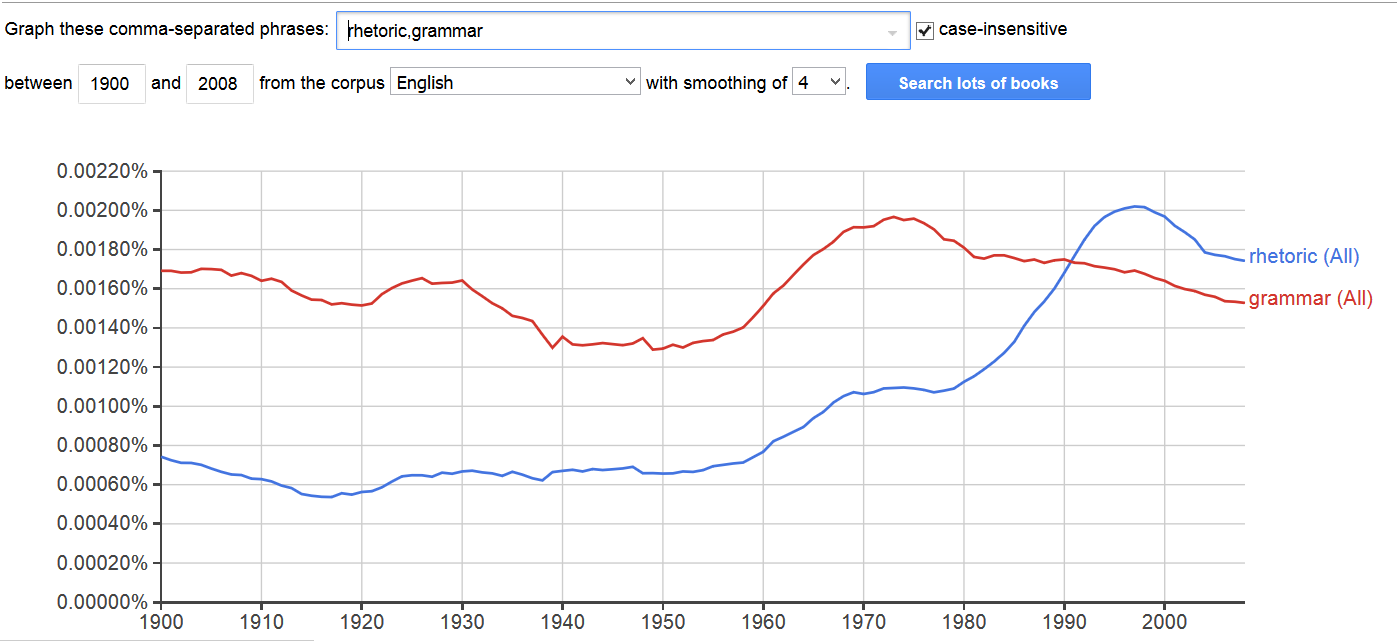
The syntagmatic and pragmatic characteristics of language are described as grammar and rhetoric by Paul de Man. De Man says this when talking about semiology. He says “one of the most striking characteristics of literary semiology is the use of grammatical (especially syntactical) structures conjointly with rhetorical structures (de Man 1368). That is to say that the syntagmatic structures of language are what is described as grammar by semiology; the pragmatic characteristics of language is what semiology describes as rhetoric. It is important to highlight that rhetoric I define as “the study of tropes and figures” (de Man 1368).

According to de Man, grammar refers to the structure of the language itself. Additionally, grammar also refers to the syntactical relationship of signs and logic. Also it has to convey a meaning both “locutionary” and “illocutionary”.  The locutionary part of grammar is the sentence while illocutionary is the tone of the sentence” “ordering, questioning, denying…” The illocutionary part of grammar seems to be a direct transition to rhetoric (de Man 1369).  Rhetoric refers to how one sentence can have more than one meaning and each of these meanings can be “mutually exclusive” (de Man 1370); this is the work of metonymies and metaphors. More importantly, rhetoric allows us to understand which meaning we should choose.

Grammar and rhetoric are very complex ideals to understand. Let’s look at the following example: In a conversation between two individuals, one of them says, “What did you just said!” Grammatically, this could mean two things: “I am very surprised by what you said” or “what you just said annoyed me.” However the illocutionary tools of grammar cannot help us decide which content is used in the conversation. Only through the means of rhetoric we can understand which definition is the correct. Yet, it does not mean that a text is rhetorical when one meaning is right and the other is wrong in a particular situation. As de Man states “The grammatical model of the question becomes rhetorical …when it is impossible to decide by grammatical or other linguistic devices which of the two meaning (that can be entirely incompatible) prevails” (de Man 1371). That is to say, that the rhetorical component is what help us find the meaning that prevails through other means that are not grammatically. It is something that is beyond the sentence content may include a whole paragraph or even the whole book.

Uncategorized

America’s Disappointing Past

Posted by Jeff Allred (he/him/his) on

Franz opens his essay with a racial slur to show his audience just how easily a human being can be put into an objectified state. His opening exclamation can remind us of times where someone could have easily have been saying things such as, “Look, a train!” or “Look, a _____”, as we often times do when an object captures our attention, or we want to bring others’ attentions to it. His unnamed speakers throughout his paper give the general effect that emphasizes how often this type of objectification occurs and how many people took part. It gave it a type of casualness, as it was during the time he was experiencing it.

When Fanon speaks about himself being a ‘third person’ or having that effect in his life, he is referring to the objectification warping the mind of the black men. He is conscious of his body in a way that it creates a certain uncertainness of his own movements because his body physically becomes his main attention because of the attention that the ‘white world’ gives it. He is under scrutiny and therefore becomes hyper aware of his own body, not only in the physical, but metaphorical sense. He talks about how the movement against this ‘white world’ caused him to live under a stronger scrutiny, which would make any person in such a serious and stressful position aware of the spotlight they are under.

The difference between white and black being based completely on physical appearance is what causes this stress on the actual color of the narrator and his people. He reflects on this when he speaks of laboratories and doctors trying to create ‘whitening’ practices in order to help the ‘Black’ change to ‘White’ in the literal sense. This goes beyond self-consciousness as the twistedness of such an absurd situation could make someone try to be ashamed of the color of their skin. Not only is the actual color being scrutinized, but the character and history of the ‘black’ people are being put into a negative perspective just based off the word “negro”. This splits the person into a “triple person” as every aspect of the being is picked apart and analyzed and in this case, all with negative connotations. This left the being cursed by these connotations of their body, their culture and their history. Every part of them neatly cut into pieces that could be ripped apart and negated.

Fanon does discuss other discriminated groups, such as the Jewish. He believes that there is a significant difference between the discrimination the Jewish face and the discrimination that the African American do. His difference is explained by the fact that the Jewish are white, there is no outer indication of their religion, unless they are outwardly representing it, but they must be ‘found’, while the black man is pointed out and cannot even be considered found, but identified, making the skin an indicator or scarlet letter of sorts. Their own skin is betraying them, and they have nothing to hide from being identified (unless they are light skinned). He is “overdetermined from without” (page 5) by the fact that he is stripped of his own individuality and cut down by the perspective of the world around him, slicing away pieces of his humanity so that they can see him as they believe him to be. Nothing more or less of their expectations and ideas of a black man.

Fanon’s essay puts the idea and connotations of ‘black’ in a ‘white’ world into perspective of readers as he examines what it is for him to be black in a world where language is used against his entire race in order to brand him, take away his individuality and doom him. It is disgustingly sad to think that such a time existed in any world and caused any person to feel the way Fanon expressed his emotions.

Uncategorized

the “fetishism of commodities”

Posted by Jeff Allred (he/him/his) on

I was thinking about how to talk about the except from Capital that we’ll be discussing tomorrow, the famous riff on the “fetishism of commodities.”  And I thought about commercials, naturally, especially the amazing Apple ads in the first decade of the 2000s, that push Marx’s notion of the commodity as “fetish” to an extent that he scarcely could have imagined:

Apple COMPLETE iPod “Silhouette” ad campaign compilation (2004-2008)

No Description

And I really wanted to show the one with disembodied hands playing “Heart and Soul” on a virtual keyboard on an iPad, but all I can find are hundreds of people offering to teach us how to do it ourselves.  I’ll leave it to you to figure out what Marx would say about YouTube:

Apple iPad Mini Commercial Song – Heart and Soul

After watching the iPad Mini ad, I decided to try to play that myself. I got my iPad 2, learned the song from watching the ad repeatedly, and videotaped me playing it.

Finally, here’s a spoof of the original commerical that performs a bit of “ideology critique” by way of satire:

No Title

No Description

And of course no discussion of Marx and Apple would be complete without a discussion, at least glancingly, of the way Apple’s products embody both the “fetishization” process and the grim face of the “alienation of labor” that Marx examines in Philosophical and Economic Manuscripts of 1844.  This report from China Labor Watch from 2012 gives some sense of how, as Marx and Engels put it in the mid-19thC, the “animal becomes human, the human becomes animal” today.

Uncategorized

Marx today

Posted by Jeff Allred (he/him/his) on

First off, I want to say I’ve really enjoyed reading your posts.  Keep up the good work on that.  And don’t forget to look at the study questions available via the homepage as you read.

Second, although Marx is the oldest writer we’ll be reading this term and might be thought to be irrelevant after the post-89 collapse of the Soviet Union and many supposedly “Marxist” governments around the globe, one finds Marx everywhere these days, and not only among left-leaning humanities scholars in the academy.

One notable such place is the wonderful publication Jacobin, a relatively new magazine/site that is infused with Marxist modes of thought/practice, a global perspective, and a youthful vibe that shows the deep relevance of Marxist ideas in our moment of looming ecological catastrophe and ever-increasing inequality.

Another is the awesomely comprehensive collection of Marx’s and Marxists’ work at marxists.org, which collates a deep, deep trove of e-texts and distributes them for free.

You might be interested in Raoul Peck’s recent biopic of Marx, The Young Karl Marx.

For those interested in taking a deeper draught from Capital than the Norton gives you, CUNY’s own David Harvey has made available his classic lectures/discussions that walk through all three volumes of Capital: I‘ve linked to the episodes for Vol 1, but there’s much more there.  For when you have a few hundred hours of free time.  And that’s not counting doing the actual reading.

Uncategorized

The Exchanging of Words and Money

Posted by Jeff Allred (he/him/his) on

Ferdinand De Saussure’s analysis of language alludes to Nietzsche’s theory on lying and human’s false cognitive truths, though Saussure’s theory took the analysis one step further than Nietzsche’s, they are relatively one in the same. Saussure’s theory, like Nietzsche’s, explains how humans attempt to use an arbitrary system based on sound or language to capture the tangible and make it intangible for learning and speech purposes. The words that Saussure uses while theorizing is Signified and Signifier. Where the Signifier is the sound or written word and the signified is the concept that is lent to the sound. The actual object or “ding un sich” is referred to as the referent. A signifier may not exist without a signified or rather lacks meaning without a signified. And while a signified may exist the meaning of a signified may change between persons and context. The relationship that exists between the two are considered arbitrary relationships and are only as real as they are made. Nietzsche elaborates on his theory by explaining how value is equated with signification. Nietzsche says, “(1) of a dissimilar thing that can be exchanged for the thing of which the value is to be determined; and (2) of similar things that can be compared with the thing of which the value is to be determined” (858). In this case, the signified is being exchanged for a signifier or a word is being exchanged for a meaning. The value is determined by the sender and receiver or group of persons in discussion. The idea that is lent to a word is not fixed, it is capable of being exchanged so long as it is stated that it is being exchanged. In this way language is very much like money.

Saussure explains that money and language are similar in the ways that they can be exchanged for similar or dissimilar things. Money may be exchanged for something of a fixed quantity. Something such as a bag of apples may be purchased for $3.00. While you may also go to another country and exchange a U.S. dollar for the equivalent $16.90 Pesos (in Mexico). If one wanted to delve deeper into the comparison of money and words one could also argue that language and money are alike in that they are both the Signified. Like words, money means nothing without the signifier behind it. In this case each country has an amount of gold that signifies how much their dollar, peso, pound, rupee, etc. is worth. The referent is gold, the dollar is the signified and the signifier is the value we put with a dollar. Money and language are alike in many ways. In both cases we have signifiers and a signified and we also have exchanges and arbitrary equivalents.

Uncategorized

Pursuance, or I Don’t Quite Get de Man

Posted by Jeff Allred (he/him/his) on
Pursuance, or I Don’t Quite Get de Man

Continuing in a line of thinkers pursuing an understanding of how exactly language does, de Man maintains a Structuralist’s careful eye to inner cleavages—reading from “an inch over the text” (1362) and accepting the idea that Text is, to start, some internally working whole. Like his related ideological predecessors Nietzsche and Saussure, Paul de Man shows curiosity about peering under the skin of seemingly autarchical words, interdependent (but destabilized?) atoms that create vivid pieces of literary text. Noting “a highly respectable moral imperative that strives to reconcile the internal, formal, private structures of literary language with their external, referential, and public effects”, he nods to a concern akin to semiologist and linguist Roman Jakobson’s, who took a close eye to the difference between the associative function (the way that in metaphor, one associated word is replaced for another, for de Man called “paradigmatic) and the syntagmatic (the means by which words relate horizontally and temporally, and constitute metonymic meaning).

Admittedly, the challenge seems a sprawling one, and I am often left following de Man’s argument with focused eyes that fail to see through murky waters.

Paul de Man writes on 1368 of how “one of the most striking characteristics of literary semiology […] is the use of grammatical (especially syntactical) structures conjointly with rhetorical structures without apparent awareness of a discrepancy between them.” By rhetoric, he claims to here be speaking of “the study of tropes and figures”—specific way words interrelate to create certain modes of meaning. His issue with writers like Ducrot and Todorov is that they have traditionally treated this rhetoric more as merely a paradigmatic view of words without strong question of they work when contiguous. Heralding one of Jakobson’s concerns at the conclusion of Metaphor and Metonomy, de Man treats a passage of Proust’s Swann’s Way to uncover that there is an abundance of figurative language in which both these modes of language are used in a conjoined fashion, leading to an almost exasperated conclusion: Why has the combination of both been only treated descriptively and nondialectically without considering the possibility of logical tensions?

At this point in his argument, de Man finds a moment to pit stop at the ideas of J. L. Austin regarding the performativity of language: the notion that language is more than descriptive of the world (which has relevance with the map semioticians think about words mapping onto real underlying things), but that enunciating language—utterance, if you will—constitutes an action in itself. Austin postulated the tripartite division of speech acts as locutionary (saying something meaningful), illocutionary (saying something meaningful for some purpose), and perlocutionary (having an effect on those who hear what is said).

In this step of the work, we are juggling a variety of perspectives, this most recent one transcending purely literary concerns and acutely aware of language as taking part in action. Attempting to elucidate his definition of rhetoric, he sets up a semi-helpful dichotomy: grammar, concerning internal relationships between sound, syntax and meaning, is somewhat akin to the illocutionary act; rhetoric, traditionally exclusively a way we describe the perlocutionary way of persuasion, is created only by dint of grammatical function, and so thus “the continuity [between the two] is self-evident”. Admittedly, this is somewhat less so for me, still unsure of what he means by rhetoric, and if I have all the meanings straight: our traditional way of speaking about persuasive oratory, but also another way of describing the poetic ability of language—how indeterminacy of language, which he refers to on the next page with a discussion of Pierce and the infinite deferral of the signified, creates an excess of infinitely refractive meaning. But de Man’s endgame here is to craft the “basis for a new rhetoric that […] would also be a new grammar” (1369).

I’m tempted to give up at this very early point in the text with a formal declaration of defeat. The kind of stability I am looking for in terminology seems nowhere to be found in the work etiquette of the deconstructionist de Man. And more so, the whole point of creating instability seems to run counter to any act of elucidation looking for an easy point A to B to C, in the way I have been proceeding here.

As a kind of white flag, I want to tie back, with his oppositional arrangement of “rhetorization of grammar”, the way in which poetic meaning makes interpretation along grammatical lines impossible. To complement this, de Man touches on the “grammatization of rhetoric”, using his account of Proust to show that figural language can run along the lines of “semi-automatic grammatical patterns”, initially deceiving us into a certain mode of analysis that de Man contests that validity of. In conclusion: the reader is left with nil: there is no safety, no useful guidelines, “the same state of suspended ignorance”. The illusory prize of an indeterminably nebulous language seems like barely any prize at all.

Uncategorized

“Being” Versus “Doing

Posted by Jeff Allred (he/him/his) on

Barbara Johnson’s mode of criticism notably stems from the postmodernist ideas and Melville’s text has elements that can be drawn to the postmodernist era by looking into the relationship between the signifier and the signified, or rather the distinction between “doing” and “being” exemplified by his symbolic characters. By understanding how the text works through allegorical functioning, she is also able to identify the disconnect between the signifier and the signified. This distinction between “being” and “doing” she brings forth by explaining the ways in which Melville describes the characters of Billy Budd, John Claggart, and Edward Fairfax Vere, sound like expectations of what they should be like and how they should be perceived. However the counteracts of these characters display the irreconcilable relationship between the two concepts.

The most prominent example being that of Billy Budd’s character who should represent the Handsome Sailor stereotype, but in being mute is unreliable in communicating his actual identity and so it is unforeseen when he becomes the flawed character. From a psychological perspective, it is possible to “be” one person implicitly and “do” contradictory actions based on what is perceived as acceptable behavior at individual versus social levels, and so I argue further that it is in “human nature” to embody acts of both “good” and “evil” such that there no fully moral or fully unmoral person, leading to what seems to be counteracts of the characters’ personalities. In this same way, different modes of communication can be misinterpreted, especially in literature. There is a consistent uncertainty between the messages being conveyed.

Billy Budd’s lack of intelligence provides an absence of his character, leaving an ambiguity of who his character is by only leaving what is said of him and his expressions. Ironically, though his character cannot understand double meanings of things Billy embodies the very idea that what something looks to be is not necessarily what is. Therefore, his character makes it difficult to read motivation and intention by simply looking at his actions. It is then surprising when he is accused of murder of the “evil” character, Claggart, who had previously warned Captain Vere to avoid falling into the handsome act. Though Johnson exclaims Billy as a transparent character, I argue that he is not easily read simply by the descriptions Melville provides because the narrative is missing. I also argue that Claggart’s speech could have been misinterpreted and disregarded as “good” because his “very pleasantness can be interpreted as opposite” (2262). He is said to uphold a “duplicity, both in his appearance and in his character” and so he personifies the difference between the signifier and the signified. I think that instead, his character is misread and represents a truthful and honest character. The personalities of these characters intertwine, leading me to believe that the nature of man is the same as the nature of literature. It is almost always left up to interpretation. What is at one moment, will not be the next, as there is almost always a duplicity in human nature. Handsome is, is therefore not always what handsome does.

Uncategorized

Is Paul De Man the man?

Posted by Jeff Allred (he/him/his) on

The reading that is up for discussion and interpretation is called Semiology and Rhetoric. First and foremost let’s first look up the definitions of semiology and rhetoric. Semiology is defined as the study of signs and symbols. So what is Paul De Man’s purpose of the discussion on semiology? And why is semiology so important for his argument of language and grammar? Before we get to that we first need to also define rhetoric. Rhetoric is defined as the ability to use language effectively. So the purpose of Paul De Man’s writing is to study the signs and symbols  of language and how to use it. First Paul De Man uncovers the past famous works on language and grammar and criticize their theories because even though they explained language in an accurate manner some inaccuracies were at play. The main problem was that they explained a system for language where as there is more to the theories crafted by the past theoretical works of the 19th century.  Paul De man instead believes that there are a connection to both rheteric and semiology which we can not really seperate from one another. He even explains that metaphors are even more tenacious than facts! This is true considering the impact metaphors have over traditional factorial information. He then brings up examples of semiology with different quotes from French literary writers. They all state that rhetoric language bring symbols upon symbols. In fact symbols give birth to new symbols. This is intriguing to me because so far what we learned from the past few readings was how we learn language with images and our understanding of language is related to the human idea of objects. The difference in belief from Naiditch’s and Paul Da Man’s belief is that words have and symbols have their own meaning. We created meaning through semiotic and rhetoric relationships not through human ideas of objects. After he exemplifies his main ideas behind the relationships of rhetoric and semiology he uses a famous poem as an example of his argument. The peom states as follows:

“O chestnut tree, great-rooted blossomer, Are you the leaf, the blossom or the hole? O body swayed to music, O brightening glance, How can we know the dancer form the dance?”

This famous line came from Yeat’s poem “Among School Children” and Paul De Man makes his most important point about his arguement. That words that impact people do so in an extroadinary way in which semiology and rhetoric reasoning makes the reader grab the words and a blissful manner which is strong than factual sentences.

Uncategorized

“Thought You Knew English?”

Posted by Jeff Allred (he/him/his) on

Language, for me, has always been an interesting subject matter.  On a daily basis, I interact and speak with many people, in the only language that I’ve known—or thought I did— English.  New York City, being the epicenter of global finance and trade, attracts people from all over the world that are in search of opportunity and growth.  Accompanying the constant stream of citywide diversity, are the ways of which these diverse peoples communicate amongst each other: and in America, everyone speaks English.  In a crowd of English speakers, one that speaks English should be able to comfortably relay their thoughts in English, Yes?  Not exactly, and the discomforts lie in the different ways in which a single language can be expressed and interpreted.  People, sometimes think, act and express themselves in ways that are often misunderstood by others.  The English language can also be, often, misunderstood because of its ambiguity in being relayed and received.  Users of the language all agree to the fundamental guidelines of English, which structure sentences into paragraphs and paragraphs into pages.  Pages written by Paul De Man, in the form of an essay, describe certain confusions caused by grammar and rhetoric using late 1970’s sitcom characters as examples.

Edith and Archie Bunker, share a long marriage that is not strictly derived from intense verbal interactions with one another; but one with the values (and issues) of the average, working class household.  Edith understands her husband’s locution after many years of marriage, but fails to understand his rhetoric when he asks the question ‘“What’s the Difference?”’(1370) Pertaining to Archie’s bowling shoes being laced over or laced under, Edith receives his message in grammatical context, only; rendering her completely absent from the substance of his statement.  Archie relayed a message that was simultaneously literal and figurative, or rhetorical.  In transmitting such a message (and for effectiveness) the receiver must be able to understand both the literal and the figurative nature of the message relayed.  Archie also asks his question in a metonymical sense, which infers that both options offered by Edith are the same in value toward the subject of bowling.  Had he chose a preference amongst the options, Archie would be agreeing to Edith’s grammatical approach; instead he choses rhetoric—or an implied meaning— as a response.

“…Grammar allows us to ask the question, but the sentence by means of which we ask it may deny the very possibility of asking.”(1370,71)  By addressing a question, the context is unknown to the addressee—unless they are familiar with the subject matter.  The addressee is as foreign to the subject, as two people attempting to conduct a conversation in two totally different languages.  More times than often, this collapse occurs with people that are speaking the same language.  A (hypothetical) British gentleman and American gentleman are sitting in a bar, sometime in the present, engaged in deep political debate; when suddenly the British gentleman asks the American, “Are you taking the piss?”  The American—if unfamiliar with British rhetoric— will be confused with the question and respond with a polite grammatical retort, “No. But the bathroom is in that direction.”  This response indicates the unfamiliarity of the Brit’s syntactic mode, causing confusion with the American.  The British gentleman was definitely not inferring that the American was impolitely urinating during their discussion; but that he was being mocked by the American for his, drunken, political views.  They both are using the English language to communicate; however, the syntactic bridge, which once allowed the conversation to effectively prevail, has now been severed (causing confusion).  If the American is familiar with British figurative speech, the bridge may still be intact: potentially offering both gentlemen another round of pleasant debate, along with another round of beer.

Skip to toolbar